What happens to your pet if an emergency suddenly leaves you unable to care for them? Whether you’re hospitalized, delayed away from home, or unexpectedly unavailable, someone else may need to step in without knowing your pet’s daily routine, medications, or veterinary contacts.
A clear pet care handoff can bridge that gap. It gives a backup caregiver an up-to-date picture of your pet’s needs, what care has already been completed, what needs to happen next, and who to contact if something goes wrong. The information should be simple enough to follow under pressure and detailed enough to prevent dangerous guesswork.
Build the sheet for a transfer, not just a trip
A vacation checklist assumes time to explain the routine. An emergency handoff assumes the usual caregiver may be unreachable, distracted, hospitalized, delayed, or unable to answer questions.
Name the person currently responsible for care and the backup who will take over. Add the date and time the handoff becomes active, when it is expected to end, and who should be contacted if the first backup is unavailable. Ready.gov and the CDC recommend a buddy system so a trusted neighbor, friend, or relative can care for or evacuate pets when the owner cannot.
The backup should know where the pet is, how to enter the home safely and with permission, and where the carrier, leash, food, medication, records, and emergency supplies are stored. Do not put alarm codes, passwords, full payment-card details, or other sensitive access information on a sheet that could be lost. Arrange secure access separately.
Make each pet unmistakable
Start with information that distinguishes one animal from another: name, species, breed or type, color, approximate weight, sex, and a recent photo. Include the microchip number and registry, if known, along with the pet’s collar or tag details.
A microchip is not a GPS tracker. It carries a unique identification number that helps a veterinary clinic or shelter locate the associated registry. Its usefulness depends on registration details being current, so confirm the owner’s contact information and consider adding an authorized alternate contact where the registry permits it.
List any carrier, harness, leash, or restraint the pet uses and where it is kept. Note hiding places and escape risks in observable terms: “runs through the front door when it opens,” “hides behind the washing machine during storms,” or “must remain on a leash outside.” These descriptions are more useful than labels such as “difficult” or “anxious.”
Record the routine and what normal looks like
A caregiver needs enough information to preserve the pet’s usual day without guessing. Write the food name, measured amount, feeding times, water routine, potty or litter routine, exercise pattern, sleep location, and any household rules that affect safety.
Describe the pet’s normal behavior in plain language. Useful examples include “usually eats within ten minutes,” “drinks after the evening walk,” “typically has two bowel movements each day,” or “may skip breakfast but eats dinner.” Avoid turning an observation into a diagnosis. “Coughed twice after drinking at 8 a.m.” is an observation; “has a respiratory infection” is a diagnosis that belongs to a veterinarian.
Add a short section for changes noticed before the handoff. Include what was seen, when it began, how often it occurred, and whether the veterinary team has already been contacted. A timestamped description gives the next caregiver and the clinic more useful information than a conclusion such as “seems sick.”
Copy medication instructions exactly and prohibit improvisation
For every medication, copy the pet’s name, medication name, strength, amount, route, timing, and special directions from the current pharmacy label or written veterinary instructions. Record the last dose given and the next dose due. If a medication must be shaken, refrigerated, given with food, or handled in a particular way, reproduce that instruction accurately.
Keep medications in their original labeled containers and store them securely. The FDA warns that flavored pet medications may attract animals and that storing human and animal medications together can contribute to mix-ups.
The backup caregiver should not change a dose, repeat a dose after an uncertain administration, stop a medication, substitute a human product, or restart an old prescription without veterinary direction. The sheet should state whom to call when a dose is late, missed, spilled, vomited, or possibly given twice. When there is doubt, pause and contact the veterinary clinic rather than improvise.
Confirm contacts, authority, and payment before they are needed
List the regular veterinary clinic, the preferred emergency veterinary hospital, and any relevant poison-control contact. Include addresses as well as phone numbers so the caregiver does not have to search during an urgent situation. Verify that the numbers and hours are current before each planned absence.
Listing a contact does not automatically give that person permission to approve treatment. The AVMA advises owners to arrange in advance who may act while they are away. Because clinic policies and state law vary, ask the regular clinic what written authorization it requires and share the completed document with the caregiver and veterinary team.
Confirm financial arrangements directly with the clinic. Ask how deposits, spending limits, reimbursements, or emergency approvals are handled, and record only that the arrangement was confirmed, with the date and clinic contact. A one-page handoff can summarize the arrangement, but it may not replace a clinic’s own forms. Do not place a complete card number or banking information on the sheet.
Keep the pet’s current veterinary summary, vaccination records, prescriptions, and any clinic-specific authorization forms with the emergency documents. The CDC, Ready.gov, AVMA, and Red Cross include identification, veterinary records, medications, contact information, and transport supplies in their pet emergency-planning guidance.
Show what was last done and what is due next
A handoff often fails at the point between two caregivers. One person assumes the other fed the pet, gave the medication, cleaned the litter box, or completed the walk.
Use a short running log with four fields: task, last completed, next due, and initials. Entries such as “Medication – given 7:02 a.m. – next per label at 7:00 p.m. – JD” or “Cat fed 1/2 cup – 6:30 a.m. – next 6:30 p.m. – ML” make the transfer visible.
The log should report completed actions, not intentions. If a task was missed or its status is uncertain, write that clearly and contact the appropriate veterinary professional when medication or health care is involved.
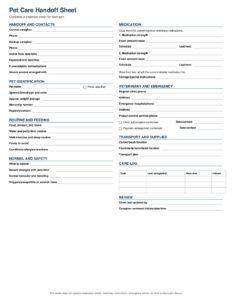
Pet Care Handoff Sheet
Keep essential pet care information organized in one printable sheet, including caregiver contacts, feeding routines, medications, veterinary details, and emergency arrangements.
Download Free PDFNo email or signup required.
Courtesy of Daniel Drabo, Pure Majesty Pets.
Test the handoff before an emergency
Give the sheet to the backup caregiver and ask them to locate one pet, one meal, one medication, one carrier, and the emergency clinic without coaching. If they cannot do so, revise the handoff system rather than assuming the caregiver will work it out later.
Practice a short transfer: “You are taking over at 5 p.m. What happens first?” The caregiver should be able to identify the next scheduled task, explain where supplies are kept, and know whom to call if the pet’s condition changes. Emergency-preparedness guidance also recommends practicing transport and helping pets become accustomed to carriers.
Ask the backup to repeat medication instructions using the label rather than memory. A test run can reveal missing measuring tools, unreadable handwriting, expired contact information, or an authorization that the clinic never received.
Keep the sheet available, protected, and current
Store a printed copy with the pet’s carrier or emergency kit and another in a clearly identified home location. A secure digital copy can help when the owner and caregiver are in different places, but it should not be the only version if power, internet access, or a phone is unavailable.
Protect private information by limiting the sheet to what the caregiver needs. Keep passwords, entry codes, full financial details, and unrelated personal records elsewhere, where only the people who need them can reach them.
Review the sheet whenever a medication, dose, diet, clinic, caregiver, address, phone number, microchip record, or routine changes. Add a visible “updated on” date even when nothing has changed. A handoff sheet without a recent review date leaves the next caregiver unable to tell whether its instructions are still current.
The goal is not to replace the owner, diagnose illness, or anticipate every emergency. It is to reduce avoidable uncertainty until the appropriate caregiver or veterinary team can take over.
References
American Veterinary Medical Association. “Microchipping: FAQs for Pet Owners.”
https://www.avma.org/microchipping-animals-faq
American Veterinary Medical Association. “Ensuring Your Pet Is Protected When You’re Away.”
U.S. Food and Drug Administration. “Medications for Your Pet: Questions for Your Vet.”
https://www.fda.gov/animal-veterinary/animal-health-literacy/medications-your-pet-questions-your-vet
U.S. Food and Drug Administration. “Properly Store Medications to Keep Your Pet Safe.”
Centers for Disease Control and Prevention. “Be Prepared: Pet Safety in Emergencies.”
https://www.cdc.gov/healthy-pets/emergency-preparedness/
Ready.gov. “Prepare Your Pets for Disasters.”
https://www.ready.gov/sites/default/files/2023-06/ready.gov_prepare-pets-for-disasters.pdf
American Animal Hospital Association. “Animal Identification and Microchipping.”
https://www.aaha.org/animal-identification/
American Red Cross. “Pet Disaster Preparedness and Recovery.”
https://www.redcross.org/get-help/how-to-prepare-for-emergencies/pet-disaster-preparedness.html
ASPCA. “Pet Sitter Safety: What to Know Before You Go.”
https://www.aspca.org/news/pet-sitter-safety-what-know-you-go
Daniel Drabo is the founder of Pure Majesty Pets, a pet wellness brand. He contributes educational content focused on practical pet care and helping owners prepare for their pets’ everyday needs. He is not a veterinarian.