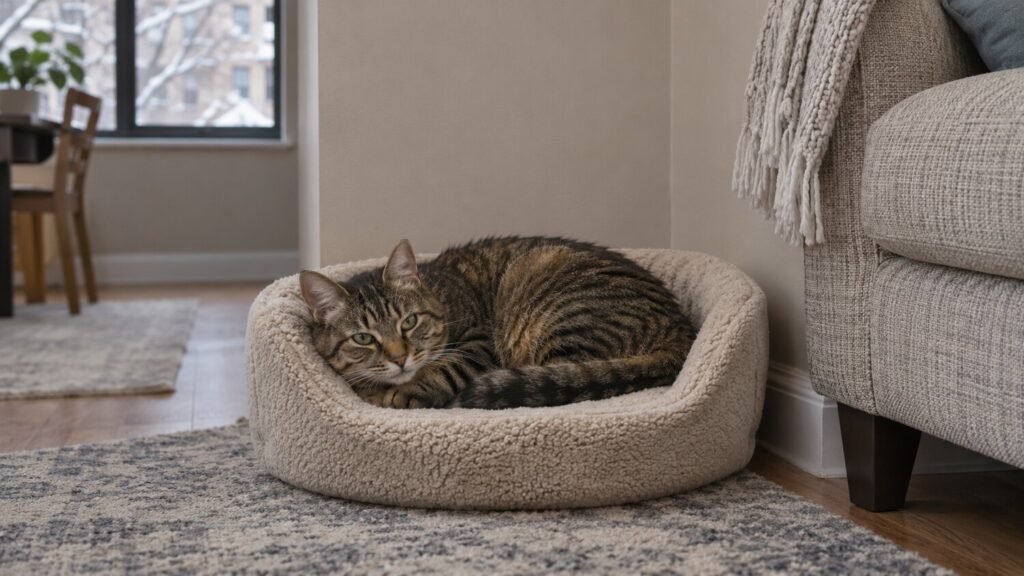
In a drafty apartment, a flat self-warming mat is usually the easiest fit for a cat that stretches out or already sleeps on a sofa cushion. An open bed with a lower front gives a cat a padded place to lean while keeping the entrance easier to approach. A round bolster bed works for a cat that curls tightly and already steps comfortably over a raised rim. All three styles can work without a cord. Their reflective layers help retain warmth while your cat is lying on them.
Match the bed to the spot your cat already uses
| Your cat’s usual resting spot | What to look for |
|---|---|
| A sofa cushion or broad chair where your cat stretches out | A flat mat with enough usable length and a stable surface underneath. |
| A corner on the floor where your cat rests against furniture | An open lounge bed with a lower front and a padded back and sides. |
| A blanket your cat bunches into a nest and sleeps in curled up | A round bolster with enough inner room to turn and lie down. |
A winter window can be sunny in the afternoon and drafty after sunset. An entry door can send cool air across the floor even when the thermostat reads comfortably across the room. Spend a minute at the height of the bed when your cat normally naps. Feel around the base of the window, along the floor, and near the door. Setting the bed beside the sofa or along an interior wall can keep it close to the spot your cat likes and out of the path of moving air.
Measure the sleeping surface and the entrance
Measure where your cat sleeps. When your cat is settled, use a soft tape or a piece of string to estimate the length and width they occupy in their usual sleeping position. Mark those measurements with paper on the proposed spot. For a bolster bed, compare that space with the inside sleeping area. Measure the outside footprint separately to see if it fits the room. Leave space for your cat to approach from the front and turn around.
A bed advertised as 20 inches long can have a much smaller cushion once the padded sides take up space. That matters for a cat that sleeps on its side with its front legs extended, even if the cat fits comfortably inside the bed while curled. Check the entrance in a side-view photo as well. The highest point at the back tells you little about the step the cat has to take at the front. When the listing gives only the overall height, the picture helps you compare shapes, but it cannot tell you the exact entry height.
On a sofa or chair, measure the flat part of the cushion between the seams. A mat that hangs over an edge can shift when the cat steps on it. On tile or wood, check how the base sits before the cat uses it. If the mat or bed moves when you press sideways on the edge, place it on a stable surface with good grip. For a cat that approaches a bed slowly, a steady landing surface can matter as much as the depth of the padding.
Three self-warming beds for different sleeping habits
As an Amazon Associate I earn from qualifying purchases.
For an existing sofa nap spot — FurHaven ThermaNAP Self-Warming Mat
The black Small ThermaNAP is a flat, 22-by-17-inch mat with a plush faux-fur surface and a self-warming core. It adds a defined resting surface to an upholstered chair or sofa without putting a wall between the cat and its usual spot. The rectangular shape also lets a cat stretch toward whichever end it naturally favors. The mat is machine washable. Check the exact care label for the cycle and drying instructions.
| Product detail | Why it matters |
|---|---|
| 22 × 17 inches, black, Small | Measure the full cushion width so the mat can lie flat and stay supported. |
| Thin, edge-free design | A cat can walk onto it directly or lie with legs extended. |
| Washable plush surface | The whole mat can be lifted for cleaning and drying. |
This format suits a cat that already likes the cushioning under its favorite resting spot. On bare tile it provides much less padding than a filled lounge bed. If the intended spot is on the floor and the cat also likes to lean its head against something, the lounge design below adds a padded edge.

For a floor bed with an open approach — K&H Self-Warming Lounge Sleeper
The 16-by-20-inch Sage/Tan K&H Lounge Sleeper has a padded surround, a lower front section, and a microfleece-lined sleeping area. The reflective material is inside the cushion, and the manufacturer describes a nonslip base. Its front still has a lip, so think about how your cat gets onto the current bed or rug before comparing the two. K&H lists the entire bed as machine washable and specifies line drying or a no-heat dryer cycle.
| Product detail | Why it matters |
|---|---|
| 16 × 20-inch outer footprint, Sage/Tan, Small | Use those numbers for floor space. Allow for the room the padded sides take up inside. |
| Lower front and padded sides | Offers an easier approach than a continuous tall rim and gives a cat a place to lean. |
| Reflective cushion and nonslip base | Provides passive warmth close to the body and helps the bed stay in place on smooth flooring. |
This is a useful shape for a cat that rests along the end of a sofa or against a folded blanket and can step over a shallow edge. For a cat that hesitates at even a small threshold, the flat mat gives it an edge-free approach. Check the floor in front of either option so the cat can plant its feet before stepping in.

For a cat that sleeps curled up — Aspen Pet Self-Warming Oval Lounger
Petmate’s Aspen Pet lounger is listed in Barn Red/Cream with an outer footprint of about 19.5 inches across. Its padded sides give a curled-up cat a surface to nestle against. Petmate specifies a heat-reflecting Mylar layer, a faux lambswool resting surface, and a nonskid bottom. The rounded shape makes good use of a corner for a cat that tucks in its feet and tail when sleeping.
| Product detail | Why it matters |
|---|---|
| About 19.5 inches across on the outside | Measure the space left after the bolsters and compare it with your cat’s curled sleeping position. |
| Padded surround with faux lambswool | Fits a cat that likes to nest against a soft edge. |
| Mylar layer and nonskid bottom | Uses the cat’s own body warmth and provides grip on tile or wood. |
The raised rim makes more sense for an agile cat that already climbs into a basket or burrows into bunched-up bedding. A cat that consistently stretches out or walks straight onto bedding may use more of the surface on a rectangular mat or lounge. Use the profile photo and the usable inside width to make that distinction before ordering.

Check the selected version before ordering. Similar product names can describe a reflective bed or a plug-in model. For a cord-free setup, look for wording such as no electricity required and verify the selected color and size. Product photos can show a roomier variant than the one in your cart.
Set up the bed where your cat can settle
Try placing the bed near the existing nap spot for the first few days. A cat that uses the armchair every evening already knows the sounds and activity around that chair. If an overnight draft is strongest there, start with a sheltered spot close by. Keep a clear route so the cat can approach or leave without squeezing past furniture, another pet, or a door that opens toward the bed. The ASPCA’s cold-weather guidance recommends a warm sleeping place away from drafts and off the floor. For a cat that cannot jump comfortably, use a sheltered, accessible spot with insulation between the bed and the cold floor.
Look at when and how the cat uses the bed. If it rests on the front edge with part of its body hanging out, check whether there is enough room beyond the bolsters. If it places its front paws on the mat and then backs away as it shifts, check the surface underneath. If it stays close to the new bed but chooses an older blanket next to it, compare the two surfaces before moving the bed again. These observations help distinguish a fit or placement problem from a simple fabric preference.
A low entrance is especially helpful if you are already making the apartment easier to move around in. Our guide to senior cat sleep covers other ways to arrange a resting area. If your cat moves between several favorite spots over the course of the day, our guide to cat bed styles explains how open and enclosed designs suit different habits.
Frequently asked questions
Will a self-warming bed feel warm when I touch it?
It usually feels like the room before your cat lies down. A reflective layer works with the heat the cat gives off, so there is no thermostat or warm-up period. The cat may notice the difference during a nap, especially on a surface that feels cold underneath. The bed itself does not warm the air around it.
Can a blanket go on top of a self-warming mat?
Check the care and use instructions for your model. A thin layer of familiar fabric can help a cat explore a new bed, but thick loose bedding changes how the mat feels and can cover its edges. For a cat that needs a stable step, make sure the fabric lies flat and does not bunch where the cat puts its paws.
Will the inside of a round bed fit a cat that sometimes stretches out?
Compare the inner sleeping area with the cat’s longest usual sleeping position. Across the middle of a round bed there is more room than there is close to the edges. If your cat often switches from curling to side sleeping, a rectangular design offers more usable space for extended legs at a similar outside width.
What should I check if I wash cat bedding every week?
Check whether the whole bed, a cushion, or only the cover can go into your washer. Also check the drying instructions and where you can let the bed dry fully. A flat mat takes less room to hang. A filled bed needs space for air to reach its cushion and sides, particularly if the care label calls for air drying.
Can a reflective mat be used in an unheated room?
Its role is to add comfort to a suitable indoor resting spot. Its reflective layer does not create heat or replace a warm room, and it offers little protection from moving air. If the room cools substantially overnight, use a part of the apartment that stays warm and accessible to the cat.