
Of the $168 gap between the lowest and highest four-night holiday dog boarding rates in our comparison, $156 was already present in the ordinary rates. Differences in peak pricing accounted for the remaining $12.
One dog · Four peak nights · Three U.S. facilities · Published lodging rates only; no tax or optional extras added to the model.
A boarding manager answering a holiday inquiry needs two figures: the total for the requested stay and how much the holiday dates add. Paws & Spells reconstructed both from posted rate cards. The seasonal charge added $20 at two properties and $32 at the third. Pickup time, room choice, and booking terms determine how closely that estimate matches the customer’s final bill.
How holiday dog boarding rates were compared
We reviewed three public rate cards on November 21, 2026: Half Moon Kennels in Iowa City, BHV’s Dallas location, and Camp Bow Wow Towson in Maryland. Each published enough information to reconstruct a standard or entry-level stay for one dog. Each facility serves its own local market. Comparing each property with itself shows what changes when an ordinary stay falls on peak dates. Comparing the three rate cards shows how different operators explain that change to local customers. We selected them for the detail on their rate pages; they do not constitute a representative sample of boarding businesses or of their local markets.
We priced four consecutive nights, all classified as peak by the property, for one eligible dog using a standard accommodation. Pickup occurs within the included window. The model assumes the requested stay meets the facility’s booking requirements. It excludes taxes, optional upgrades, house food, discounts, and charges triggered by a particular dog’s needs. The seasonal increase is part of the facility’s posted price. We have added no sales tax to the published figures and have not verified whether any tax is already embedded in them. The figures therefore cannot establish what tax a customer owes, or why base rates differ across markets. A deposit is recorded separately from lodging. This is a comparison of published terms rather than an availability check for any particular weekend. No reservation was made.
| Facility | Ordinary stay | Peak stay | Increase |
|---|---|---|---|
| Half Moon | $160 | $180 | $20 |
| BHV Dallas | From $280 | From $300 | $20 |
| Towson | $316 | $348 | $32 |
The seasonal increment is the modeled peak subtotal less the subtotal for the same four ordinary nights at the same location. Dallas publishes a starting price, so both of its room totals are lower bounds. Towson’s table lists $79 for standard boarding and the page gives an $8 seasonal supplement. We apply that fee to each modeled night. Half Moon publishes its peak rate directly. Subtracting its $40 standard price from its $45 peak price gives the $5 difference used here.
The same $20 increase leads to two different conversations
At Half Moon, a customer comparing the four-night figures sees $160 become $180. At Dallas, a customer choosing the starting private suite sees $280 become $300. Both bookings carry an extra $20 for the four peak nights. For either front desk, quoting the $20 increase alone leaves a local customer without the four-night lodging subtotal. A sign that simply announces the nightly holiday supplement communicates the seasonal policy accurately while leaving the budget question unanswered.
The percentage gives another perspective. Five dollars added to $40 is a 12.5 percent increase. Five dollars added to a starting rate of $70 is about 7.1 percent at that price point. Towson’s $8 on $79 works out to about 10.1 percent. The highest dollar supplement in this comparison falls in the middle when measured against the underlying rate. That distinction matters if a management team is comparing competitors before revising its own prices: ranking the dollar amounts and ranking the percentage changes answer different questions.
Across the three modeled stays, the gap between the lowest and highest peak subtotals is $168. Of that amount, $156 was already present in the four-night ordinary subtotals at those two properties. Only $12 of the gap comes from their different seasonal increases. This arithmetic tells us where the visible difference sits. It cannot tell us which property offers better value, whether their costs are similar, or how many customers would switch if either changed its prices.
A four-night quote has more than one clock
Half Moon describes a per-night charge with a noon checkout boundary. A departure after noon adds a half day. The Dallas location measures a boarding day from the time the dog arrived, then allows a four-hour grace period before a late pickup triggers a daycare-equivalent charge. Consider two dogs with the same four overnight stays and the same planned 1 p.m. pickup. A 10 a.m. arrival in Dallas puts that pickup within the stated grace period. The same 1 p.m. departure at Half Moon falls after its noon cutoff.
We have not assigned a dollar amount to either late charge in the comparison. The example isolates the timing rule; the facility would need to confirm the applicable amount for the actual reservation. For a booking manager, the practical issue is where the software stores that information. A checkout warning set to appear at noon for every reservation makes sense under one model. Under the other, the system also needs the original arrival time. If the front desk changes arrival from morning to afternoon, the customer’s included pickup window can change with it.
Half Moon also lists a two-night minimum for holiday boarding and closes to arrivals and departures on holidays. Those conditions can matter more than the nightly supplement to a family planning a single overnight. For the local front desk, the nightly price alone cannot answer a request for a single holiday overnight. The first question is whether the dates and the requested handoff are available under each facility’s rules. Showing an eligible arrival and departure before presenting a total prevents staff from having to retract a quote for a stay the business cannot accommodate.
A deposit answers a different question from a room rate
Dallas publishes a $50 deposit to confirm a holiday booking and a five-day holiday cancellation window tied to forfeiting the deposit. A client asking what it costs to reserve the starting suite for the modeled stay may be asking either how much is due immediately or how much lodging will cost overall. The booking team needs two figures. Adding the deposit to the lodging subtotal as if it were an extra night or a seasonal fee would change the comparison without evidence of an additional lodging charge.
This distinction also affects the information a manager can take from an abandoned reservation. Someone who leaves after viewing the rate may be reacting to the total. Someone who leaves when asked for a deposit may be uncertain about travel dates or about what happens if plans change. A count of unfinished bookings cannot distinguish those explanations on its own. A useful internal review could record at which step people stopped and what question they asked the desk, then compare patterns across equivalent booking periods. The three public pages provide no basis for attributing cancellations to a specific policy.
What the room subtotal buys
Towson describes daytime play, a private sleeping cabin, feeding, and medication administration among its standard inclusions. Dallas distinguishes its private suite from a higher-priced VIP option and lists house food separately at $4 per day per dog. In the model we keep the Dallas dog in the starting suite and leave house food out. A client relying on the facility to supply food would need a revised estimate using the actual number of chargeable days. The four nights in our model do not, by themselves, establish how many feeding days a particular reservation would incur.
For a multi-location operator, this is a reason to review the language around the word “standard.” A standard room is a category within a property. It does not establish that two locations deliver identical play schedules, staffing arrangements, room sizes, or individual attention. The published comparisons can support a useful discussion of how a business describes its offer. They cannot support a claim that a lower-priced room delivers equivalent care or that a higher room rate necessarily funds more staff time.
A Four-Night Quote Check
Start with a real inquiry stripped of identifying information. Give the same arrival date, departure date, handoff times, room type, and number of dogs to the person maintaining the website and to the employee answering the phone. Ask each to produce a written quote using the published policy. Differences between their answers reveal something a competitor price survey cannot: whether two parts of the same business can translate a customer’s itinerary into the same bill. A discrepancy is actionable even when the underlying rates are exactly where management wants them.
Then repeat the exercise after changing a single detail.
- Move pickup from morning to afternoon.
- Replace a peak night with an ordinary night at the edge of a holiday period.
- Ask what happens if the customer cancels shortly before arrival.
Keeping the original quote alongside each revision makes it possible to identify the sentence, date boundary, or missing field responsible for the change. It also gives the manager a way to distinguish a staff training issue from an ambiguity in the published policy or a limitation in the booking system.

FREE EXCEL WORKSHEET
Holiday Dog Boarding Quote Worksheet

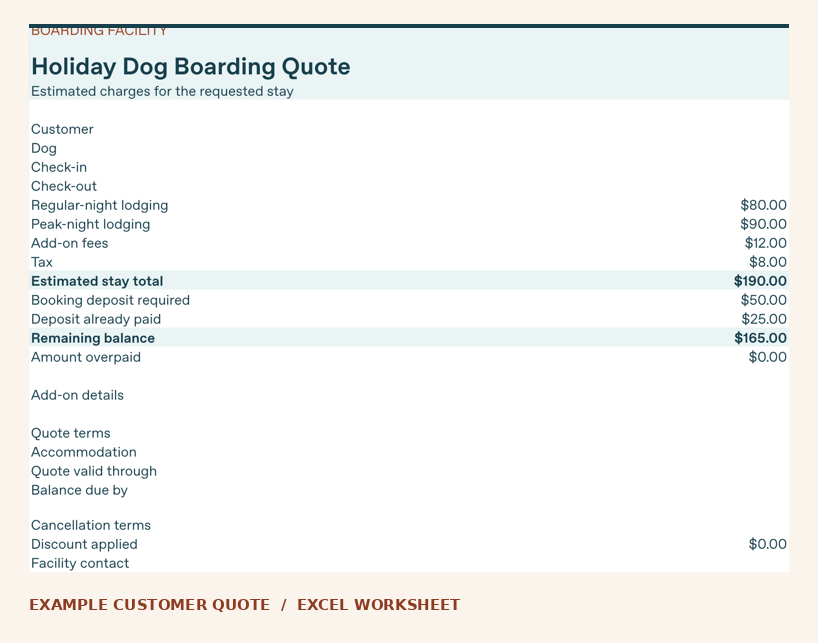
Enter your regular and holiday rates, add-on fees, and deposits. Excel calculates the balance and prepares a one-page quote you can print or send to your customer.
A final question belongs to the owner reviewing the holiday rate itself. Does the business want to recover an identifiable increase in operating costs, manage scarce rooms, or change which lengths of stay it accepts? Those decisions call for local evidence such as staffing expense, occupied room nights, rejected inquiries, cancellations, and pickup patterns. Published competitor rates cannot supply those figures. What these three rate cards do establish is a practical standard for communication: the team should be able to explain the seasonal increment, the lodging subtotal, the amount due at booking, and the event that would change the quote. That is a clearer deliverable for the next pricing meeting than a comparison of three nightly fees.