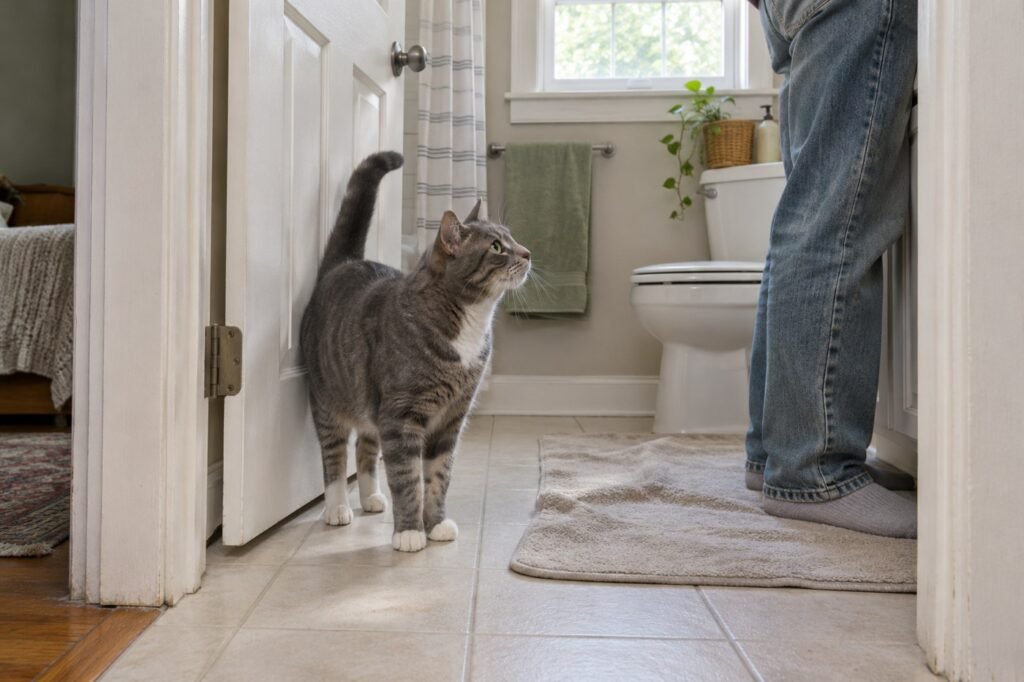
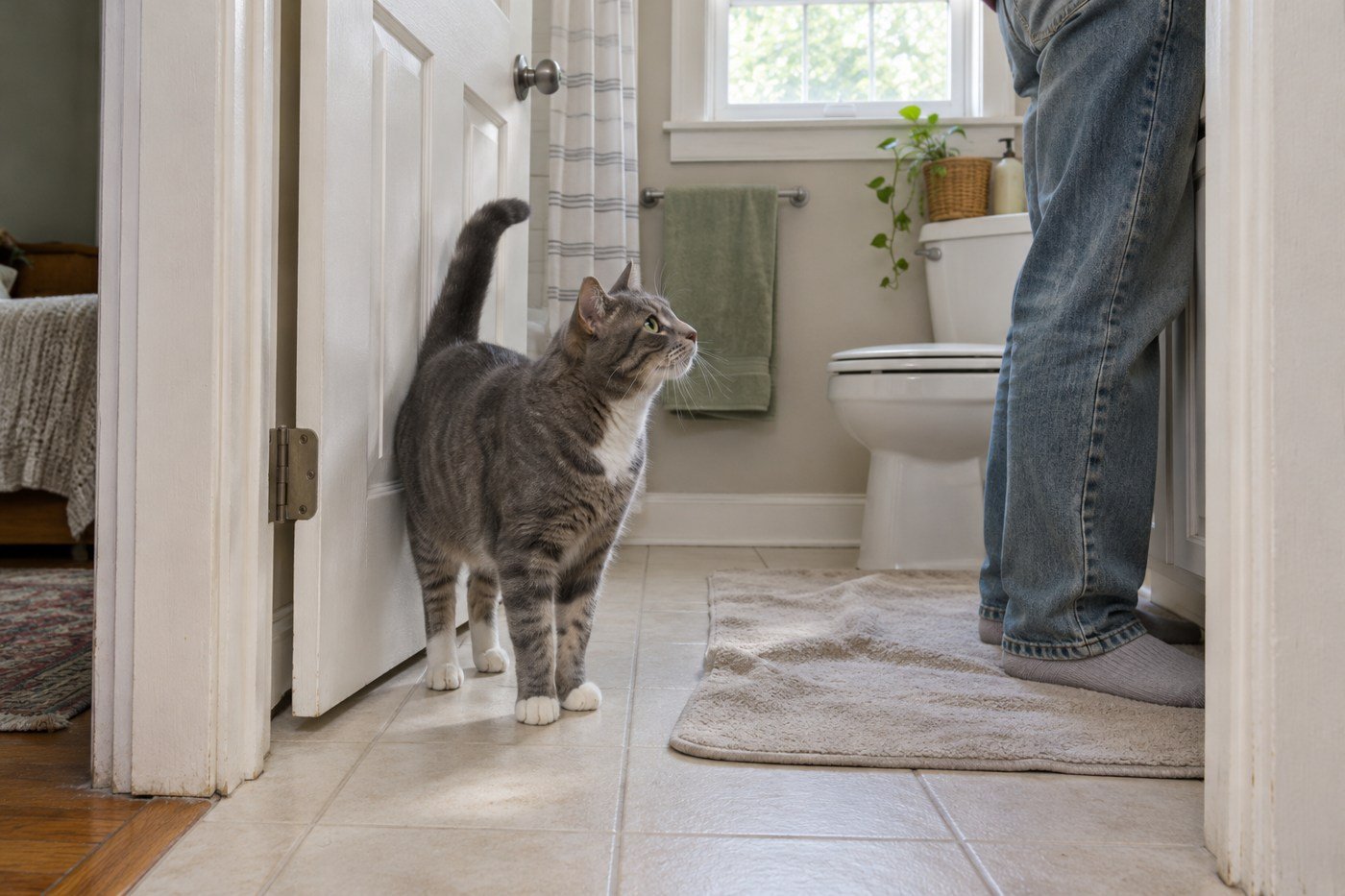
Your cat may follow you to the bathroom because the door opens onto an interesting space, the visit predicts something familiar like breakfast, or it likes resting close to you. Watch what happens when you enter and leave. A cat that checks the bath mat and settles gives you different information from one that paces, scratches, or cries each time the door closes.
What draws your cat to the bathroom?
An open door is a chance to explore
A door that’s usually closed gives your cat somewhere new to investigate. The bathroom has different sounds, smells, and surfaces from the rest of the house. One cat might head for the cool tile, while another listens for the tap. If your cat slips in when anyone opens the door and goes straight to the same spot, the room itself may be the attraction.
Your cat knows your routine
Cats can learn the order of everyday events. If you usually feed your cat after you get ready in the morning, the trip to the bathroom may be the first cue that breakfast is coming. A cat who runs ahead at the same time each day may be responding to that pattern. Think about what usually happens right before and right after the visit.
They may simply enjoy your company
Some cats prefer to be near you while you’re busy. They might rub against your ankle or curl up nearby while you brush your teeth. If your cat also sits close while you read or work, the bathroom visit may be one more part of that pattern. A relaxed cat can enjoy being nearby and still choose to spend time alone. Cats Protection’s guide to following behavior explains why ordinary curiosity and social behavior can be part of this pattern.
Notice what your cat does first
The first ten seconds after the door opens can tell you more than the fact that your cat followed you. Imagine two cats on the same morning. One walks straight past you and sniffs the bath mat. The other stays close to your feet, then leaves when you walk back into the hallway. The first may be interested in the room; the second may be keeping track of where you go. A third cat might run to the kitchen as soon as you put down your toothbrush. In that case, the routine may matter more than the room.
Watch the same situation a few times before drawing a conclusion. A cat can be curious about the bathtub one evening and follow you for breakfast the next morning. The goal is to recognize the pattern that occurs most often and notice when it changes.
| What you see | A possible explanation | What to look for next |
|---|---|---|
| Your cat heads for the same tile, mat, or window. | The spot itself may be appealing. | Do they go there when you are in another room? |
| Your cat waits at the door and walks away after you leave. | They may be following your routine or enjoying your company. | What usually happens after your bathroom visit? |
| Your cat meows once at a closed door, then settles. | Brief frustration or curiosity may be enough to explain it. | Can they move on without you opening the door? |
| Your cat paces, cries for longer, or struggles to settle in other situations too. | The wider pattern deserves attention. | Note when it happens and whether eating, sleep, or litter box habits have changed. |
Separate the routine from the room
If your cat follows you mainly in the morning, watch what happens on a day when you get ready later than usual. A cat who waits near the kitchen at the usual feeding time may be anticipating breakfast. One who follows you even when someone else has already fed them may be more interested in your company or in the room. You can observe this during normal life; there is no need to delay meals or shut the cat out just to test a theory.
The bathroom can also be appealing when the rest of the house is busy. It might offer a quieter floor, a familiar mat, or a moment away from a dog or a child. If you notice your cat using the bathroom as a retreat, look at the rest of the home. Is there somewhere else they can rest without being followed? Can they reach a bed or a perch without crossing a noisy hallway? Giving them a second comfortable option lets you see whether they prefer the bathroom itself or simply want a quiet spot.
- Notice where your cat was resting before you stood up.
- Note whether they walk ahead of you, stay beside you, or go directly to an object in the room.
- Watch whether they stay when you leave.
- Record any change that started around the same time, such as a visitor, a schedule change, or a new pet.
Curiosity or stress? Watch what happens at the door
Notice whether your cat can move on when the door closes. A brief meow followed by a nap or a return to play is different from prolonged pacing, scratching, or vocalizing. Compare the bathroom routine with what happens when you leave the house, close another door, or have visitors. One behavior on its own can have several explanations.
A recent move, a new animal, or a change in your schedule may help explain when the behavior started. Write down what you see, how long it lasts, and what helps your cat settle. If the pattern looks related to stress, our guide to stressful situations and fear in cats offers more ways to spot what’s happening.
Make the routine work for both of you
If you’re happy to have a bathroom companion, give your cat a dry spot away from cleaning products and keep the toilet lid closed. If you want some privacy, set up a comfortable resting spot nearby. Offer a short play session or a food puzzle before you go in so your cat has something familiar to do.
Practice short door closures when your cat is already relaxed. Begin with a duration your cat handles comfortably and build up gradually. Reward quiet settling in the spot you’ve provided. If your cat starts pacing or crying, shorten the next practice session. Keep play and attention predictable so the bathroom door is only one of many chances to spend time together.
Set up a comfortable place outside the door
Choose a place your cat already likes, such as a low perch with a view of the hallway or a familiar blanket a few feet from the door. Start while you are both in the hallway. Let your cat find the spot on their own, then reward calm settling with something they enjoy. This may be a piece of their regular food, a short play session, or quiet attention. Keep early practice easy enough that your cat is still comfortable when it ends.
Once they are using the spot comfortably, close the bathroom door briefly and come back out. Build up the time slowly, based on what your cat can handle. If they leave the bed to do something else, they have still found a way to spend the time comfortably. The goal is for them to settle wherever they choose while you have privacy.
If several people live in the house, agree on a simple routine. For example, keep the door closed while using cleaning products and make the hallway bed available at other times. A consistent routine is easier to follow than one where the cat is invited in one minute and hurried out the next. If the cat still seems distressed during short separations, record the pattern and discuss it with your veterinarian.
Make bathroom visits safe
Put away cleaners, medications, razors, floss, and small objects before letting your cat explore. Keep the toilet lid closed and check the washer or dryer before use if your laundry appliances are in the same room. Give the cat a dry spot with a clear path out. If they’re drawn to the tap, make sure they also have easy access to fresh water elsewhere in the home.
If you keep a litter box in the bathroom, make sure the cat can reach a box even when someone needs the door closed. This is especially important in a household where another animal tends to wait in the hallway. Watch for a cat who approaches the bathroom repeatedly but leaves without going in, and look at what happens around the doorway. A separate box in a quiet, accessible location gives them another option.
When a change is worth a call to the vet
If your cat suddenly starts following you much more than usual, look for changes in eating, drinking, energy, jumping, or litter box habits. Note when the behavior began and call your veterinarian if it persists or comes with other changes. A short video can help show what happens when you close the door or walk out of sight.
Repeated attempts to urinate with little or no urine need immediate veterinary attention. If you see repeated straining with little or no urine, go to an emergency veterinarian immediately. The Cornell guide to feline urinary disease explains why a possible blockage requires urgent care.
What to write down before calling your veterinarian
A short record helps describe a change clearly. Note when the following started, whether it happens in rooms besides the bathroom, and what your cat does after you leave. Include changes in thirst, appetite, activity, and the litter box. If more than one cat shares a box, tell your veterinarian when you are unsure which cat produced a clump or stool. A short video is useful when you can record it without delaying care.
Use that record to describe what you can see. “She waited by the bathroom for several minutes twice this week and is drinking more than usual” tells your veterinarian more than “she has become clingy.” The behavior at the door is one part of the picture. The other changes and how suddenly they started help put it in context.
Frequently asked questions
Why does my cat wait outside the bathroom instead of coming in?
Some cats prefer to stay close from a comfortable spot in the hallway. Notice whether your cat can relax there or seems distressed until the door opens.
Why does my cat follow me first thing in the morning?
Your cat may know what comes next. If your morning routine usually leads to breakfast, play, or attention, they may follow you from the first step.
Can I teach my cat to wait somewhere else?
Yes. Choose a comfortable spot, reward your cat for settling there, and start with short intervals. If your cat seems distressed even with brief separations, share what you’ve observed with your veterinarian.
Is following me to the bathroom a sign of separation anxiety?
Following alone cannot establish separation anxiety. Watch whether your cat can settle when you leave or close a door, and report sustained distress across several settings to your veterinarian.
What if my cat mainly goes in to drink from the tap?
Offer clean water in an accessible spot elsewhere. Watch for a change in thirst or urine output. Tell the clinic if your cat suddenly drinks more or starts looking for water in several new places.

References:
This article was created based on information from the following authoritative sources: American Society for the Prevention of Cruelty to Animals (ASPCA)and Association of Professional Dog Trainers (APDT).