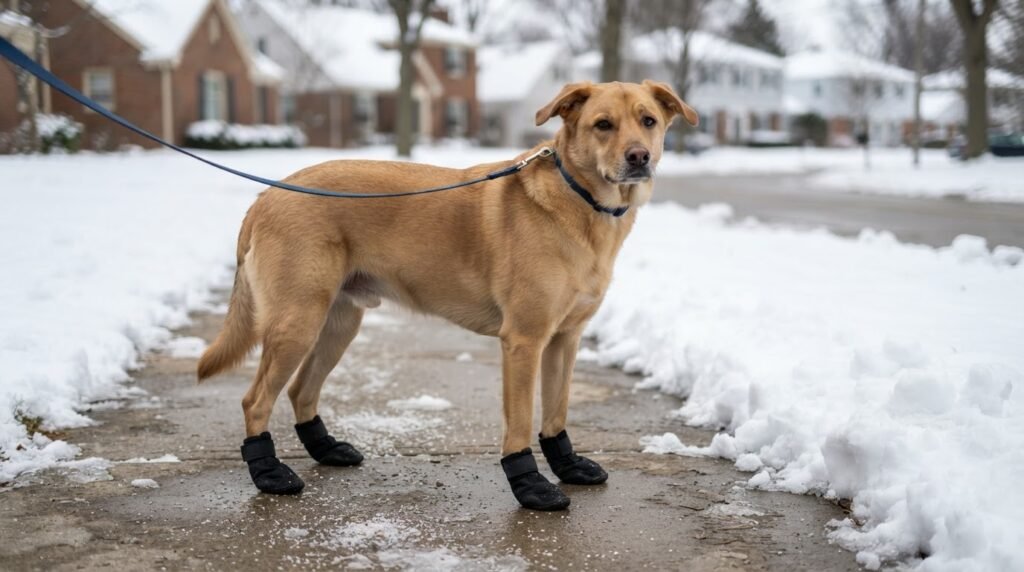
For a quick walk on salted pavement, choose a flexible boot that covers the pads and toes. For rough sidewalks that alternate between bare concrete and patches of snow, look for a separate treaded sole. For longer stretches of packed snow, look for insulation and a cuff that keeps snow out. Measure all four paws before you pick a size. A 2.5-inch measurement can mean the length of a paw in one brand and its width in another.
Think about the last walk that made you wish your dog had boots. Was it the strip of salt outside your building, the gritty pavement on the way to the park, or the snow that collected between your dog’s toes on the trail? Each points to a different purchase. If one heavily salted corner is the whole problem, crossing the street may be the easiest fix.
Which winter surface are you buying for?
| Your usual route | What to look for |
|---|---|
| A cleared sidewalk with scattered salt | A flexible rubber barrier for short trips. Start with PawZ Rubber Dog Boots. |
| Rough concrete with patches of melting snow | A treaded sole and an adjustable closure. Look at Ruffwear Grip Trex if most of your walk is on exposed pavement. |
| Packed snow with stretches of deeper snow | An insulated upper and a gaiter over the closure. Consider Ruffwear Polar Trex. |
Use the surface you walk on most to narrow the choices, then account for the hardest part of the route. A gated courtyard and a half-mile of city sidewalk can call for different boots even when they are on the same block. Watch where your dog slows down or wants to turn back. If it is always the glazed ramp outside the garage, find a safer crossing. Tread can help on uneven ground, but a boot cannot make smooth ice a dependable place to walk.
Measure your dog’s paws before comparing brands
Measure before you order. Put a sheet of paper on a firm, nonslip floor. With your dog standing on it, mark the widest points of each paw. Also mark the length using the endpoints in the manufacturer’s chart. Label each outline front left, front right, rear left, or rear right. Keep the numbers and the units beside the marks.
Why take both measurements? The blue Medium PawZ boot is sized by length. Ruffwear’s numbered sizes describe width under load. Imagine a paw measuring 2¾ inches long and 2¼ inches wide. The first number is the one to compare with the PawZ chart. The second is the one to look up for Grip Trex or Polar Trex. Choosing a 2¾-inch Ruffwear boot on the strength of that first number could put the dog in a boot half an inch wider than the measured paw.
Measure the rear feet even when the front pair seems straightforward. A dog with 2½-inch front paws and 2¼-inch rear paws needs two width decisions. A manufacturer that sells pairs lets you order two different sizes. With a fixed four-pack, check whether all four boots are identical and whether a mixed-size option exists. When a purchase goes wrong on just the rear feet, these details are worth revisiting before you try another brand.
Try to repeat a borderline measurement rather than rounding it to the size you expected. If your dog leans away as you handle one foot, let them settle and mark it again. Follow the specific chart’s advice about falling between sizes. Ruffwear recommends the smaller of its two width sizes in that situation. Keep your pencil marks so you can compare another chart without having to measure a restless dog twice.
Three dog boots for snow and salt, by use
These picks are based on the manufacturers’ sizing instructions, construction details, and the pack sizes listed for the selected models. The examples below show how those differences affect an order. Start with the section that describes your usual walk.
As an Amazon Associate I earn from qualifying purchases.
For short walks on salted sidewalks — PawZ Rubber Dog Boots
A thin pull-on boot makes sense for the dog who crosses a treated sidewalk to reach a patch of grass and comes straight back. The flexible rubber covers the paw with little material between the pads and the ground. It is also a useful starting point if a dog dislikes a thick sole. The opening still has to fit comfortably, which is something even an accurate length measurement cannot tell you.
| What you are buying | What it means at the door |
|---|---|
| Blue Medium rubber booties, sized by paw length | PawZ lists Medium for paws up to 3 inches long. Check the chart carefully around the 2½-inch boundary. |
| Pull-on opening with no fastening strap | Check that the opening lies flat and the dog can comfortably bear weight. A rolled edge or pronounced mark is a reason to take the boot off. |
| 24 individual booties in this listing | You can carry a spare if one tears. Inspect the rubber after walks on grit or abrasive concrete. |
Choose PawZ for short trips across treated pavement. The multipack makes it practical to keep a spare by the leash. If a thin sole repeatedly wears through on your route, put the next purchase toward a more substantial outsole.

For rough, mostly cleared pavement — Ruffwear Grip Trex
Grip Trex fills the gap between a thin salt barrier and an insulated snow boot. On a route where the plow leaves long stretches of rough concrete, its separate Vibram outsole puts tread between the paw and the pavement. The upper is breathable mesh. That distinction matters when the snow starts melting. Occasional damp patches are one thing, but a mesh upper is a poor match for a route where every curb crossing is under slush.
| What you are buying | What to check |
|---|---|
| Vibram rubber outsole and breathable mesh upper | Prioritize this combination for abrasive, mostly exposed ground. Choose more coverage if wet snow routinely comes up over the paw. |
| Adjustable hook-and-loop closure | Seat the paw fully, fasten the strap, then watch the sole as your dog makes a turn. It should stay under the pads. |
| Obsidian Black, 2.25-inch width, two boots | The size refers to paw width while standing. Compare the cost and sizes of two pairs when you need coverage for all four feet. |
Choose Grip Trex if rough ground is what wears out your dog’s lighter boots. On a route that stays snow-covered for most of the winter, the insulation and taller coverage of the next option are more relevant.

For longer walks on packed snow — Ruffwear Polar Trex
The Polar Trex version featured here pairs an insulated upper with a winter outsole and a gaiter over the closure. Picture a walk where your dog spends most of the outing on snow and occasionally steps off the packed path. The gaiter helps shield the closure from snow. For a five-minute trip outside an apartment, the time spent fitting four structured boots may outweigh that benefit.
| What you are buying | What to check |
|---|---|
| Insulated upper and a gaiter | Choose this coverage when cold and snow persist along the route. Check for snow or dampness at the cuff when you stop. |
| Winter tread on a structured sole | Watch your dog step and turn on a short trial walk. Continue to steer around ice sheets, even with winter tread. |
| Obsidian Black, 2.50-inch width, two boots | Size the front and back separately. Ruffwear has revised the Polar Trex design, so compare the closure and outsole pictured for your exact variant. |
Choose Polar Trex if you will regularly use the insulation and gaiter. Even with protected paws, wind and temperature still matter to the rest of the dog. Our guide to walking dogs in extreme weather explains when to shorten an outing.

Check before you buy. Read the selected color, paw dimension, size, and number of individual boots in the cart. Compare the cost of covering all four paws. A photo of a dog wearing four boots can appear on a listing that ships only two.
Check the fit before taking a full walk
Let your dog take a few steps on suitable footing. Make sure the sole stays centered, the heel stays seated, and the cuff or strap clears any area where your dog tends to rub. With an adjustable boot, fasten the closure evenly. If you have to pull the strap progressively tighter just to keep the boot on, check the size and shape before walking farther. After the first short outing, take the boots off and look for redness, damp areas, or hair rubbed flat in a narrow band.
Introduce the boots before you need them
Start on a calm day when there is time to stop. Let your dog sniff a boot, reward them for standing still while you handle a paw, then fit one boot briefly. Work toward all four in short sessions. Pick a safe, nonslip surface appropriate for the model. Some aggressive winter soles are intended for outdoor use and can damage indoor flooring. A few tentative high steps are common at first. If your dog continues to freeze, chew at the cuff, or refuse to put weight on a foot, remove the boots and check fit before trying again.
Make the first outdoor walk a short loop close to home. Watch what happens when your dog turns, backs up, or steps off pavement into snow. A boot that looks secure while the dog is standing can rotate during these movements. When you come in, take off the boots and check the paws, including the spaces between the toes. Rinse away salt and grit and dry the paws before your dog settles down to groom. The ASPCA’s cold-weather safety guidance covers booties, cleaning after walks, and ice-melt exposure.
Frequently asked questions
Can I buy just one pair to see if my dog will wear them?
A two-boot pack lets you check fit and tolerance before buying a second pair. Test it on the paw pair you measured for that size. When salt covers the full route, all four paws are exposed. Plan to fit the other pair too, or use a clearer route while you are testing. Check the number of individual boots in the listing before buying. A product image can show a dog wearing four boots even when a package contains only two.
What if the boots keep falling off in snow?
Check which boot falls off and under what conditions. A rear boot that slides off on every walk may be too wide or too long for that foot. If a boot stays in place on pavement but loosens in deeper snow, look for snow collecting around the cuff or closure. Remove the snow, reseat the paw, and fasten the closure again. If the boot still rotates as your dog walks, a different size or a model with a different shape may fit better than a tighter strap.
Is paw balm enough if my dog refuses to wear boots?
For a short outing on a mostly clear route, walk around visible piles of ice melt, then rinse and dry your dog’s paws at home. A vet-approved paw protectant can be another option for mild exposure. Balm provides no sole for grip and leaves the paw in contact with whatever your dog steps on, so use a shorter or less heavily treated route when conditions are rough. If your dog persistently licks one paw, limps, or has a red or sore spot, check the paw and contact your veterinarian if the problem persists. Our guide to why dogs lick their paws explains other possible causes.
Do I need to order a size up for socks or liners?
Use the sizing instructions for the boot you intend to buy, and check whether the manufacturer offers guidance for liners. A liner takes up space and can change where a strap sits. Try the actual combination and watch whether the paw stays centered when your dog turns. If the toes feel crowded or the heel lifts as your dog steps, reassess the combination instead of assuming a larger boot will solve the problem. For a first purchase, check whether the seller allows an indoor fit check before you take the boots outside.