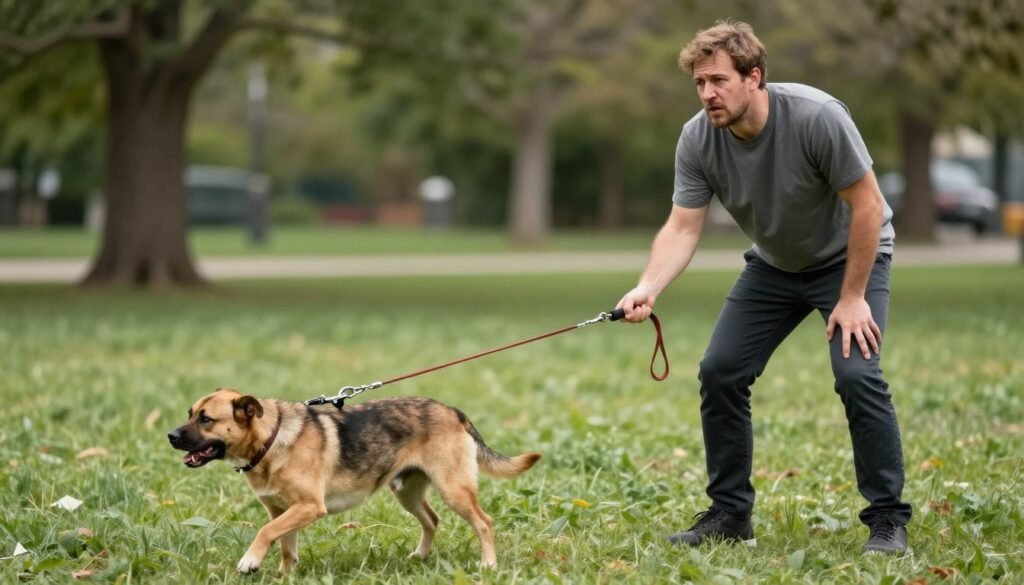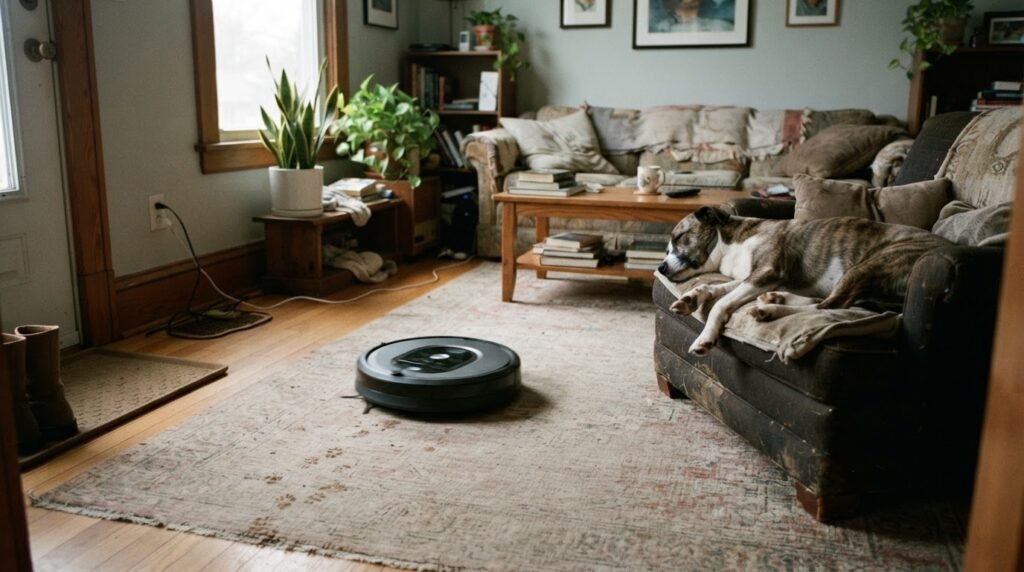
Your dog comes in from the rain, crosses six feet of tile, and settles on the hallway runner. The paw prints need water. The runner needs a brush that can lift hair caught between its fibers. Which job do you repeat even after the floor looks clean? For a rug that holds on to fur, the Roborock Saros 20 has the strongest case here. For a mostly hard-floor home that needs a fresh mop surface from the door to the kitchen, start with the eufy Omni S2 or Narwal Flow 2.
We compared five premium 2026 US models using brand specifications, launch information, and published independent testing. Our recommendations translate that evidence into ordinary dog-household routines. As an Amazon Associate, Paws & Spells earns from qualifying purchases.
Five choices for five kinds of dog mess
| What sends you back for the vacuum? | Model | The upgrade to examine |
|---|---|---|
| Hair stays woven into the runner after sweeping | Roborock Saros 20 | Carpet pet-hair pickup and an adjustable chassis |
| A low couch and a changing obstacle course of beds | Dreame X60 Max Ultra Complete | Low clearance and obstacle navigation |
| A long stretch of sealed floor shows every print | eufy Omni S2 | A self-cleaning roller and detangling brushes |
| Several hard-floor rooms get walked through in succession | Narwal Flow 2 | A track that rinses and scrapes itself during the trip |
| Dried spots gather inside the entrance; dust bags fill quickly | ECOVACS DEEBOT X12 OmniCyclone | Pre-spray and a bagless station |
Read your runner first. Lift one corner on an ordinary cleaning day. Loose hair underneath suggests the rug moves or the edges trap debris. Hair embedded on top points to a pickup problem. Grit under the rug still calls for lifting it periodically. Knowing which job you want to automate keeps an expensive comparison focused on the right surface.
Roborock Saros 20: for the rug your dog chooses every afternoon
The most revealing square foot in a dog home might be the place where a dog turns three times before lying down. Fur gets pressed into the pile there, while the surrounding floor can look perfectly clean. In a direct comparison with Dreame’s X60 Max Ultra Complete, RTINGS found the Saros 20 more effective at lifting pet hair from carpet. If you want a premium robot for this particular job, the independent result carries more weight than a comparison of maximum suction numbers.
Roborock also equips this model with an adjustable chassis for floor transitions. Follow the route from the dock to that favorite rug before deciding how much the feature is worth. The machine might have to cross a wooden saddle at the kitchen doorway and then approach the rug at an angle between a bench and a shoe rack. Measure each step and note whether the edge shifts underfoot. The largest crossing claims describe particular stepped test shapes; a folded runner can present an entirely different obstacle.
A useful first-week check takes less than a minute. Photograph the resting spot before a run, then use the same light and camera angle afterward. Use your ordinary hand vacuum on a small section afterward to see what still comes up. That comparison helps you decide where a second pass pays off and where one pass is plenty. Keep a separate tool for stairs and upholstery: the strongest floor result still leaves a favorite sofa cushion to you.
Dreame X60 Max Ultra Complete: for the places fur escapes to
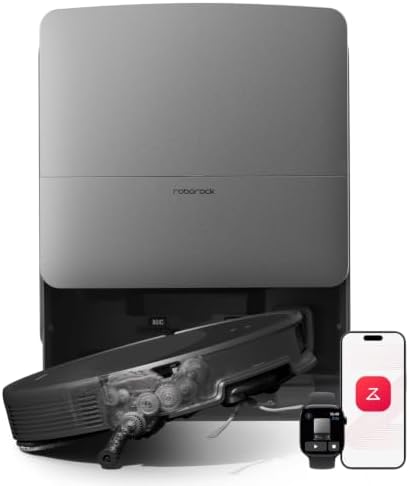
Some homes have a shedding problem in plain sight. Others have it behind the front rail of the sofa, where a Labrador’s tail sends hair drifting beyond the reach of an upright cleaner. Dreame lists the X60 Max Ultra Complete at 3.13 inches tall versus 3.5 inches for the X50 Ultra. If you have a clearance somewhere between those measurements, the upgrade could open up a whole section of floor. Allow working room and measure the lowest crossbar as well as the front opening.
Navigation is the second reason to look at the Dreame. Independent testing from RTINGS favored its ability to negotiate furniture and everyday obstacles over the Saros 20 in their direct comparison. Imagine a living room with a bed tucked beside a chair and a basket of toys on the other side. If your previous robot spent its run circling chair legs before returning home, better navigation may be worth more to you than stronger carpet pickup. A leash, knotted rope toy, or thin blanket still belongs off the route.
For a practical trial, map the room with the dog bed where it usually sits. Check the crescent of floor that collects hair behind it. Then move the bed for its regular wash and clean that patch separately. A premium navigation system can approach a bed more successfully; it cannot clean the rectangle the bed occupies. This distinction matters if you expect to stop moving furniture altogether. What the slim body can spare you is dragging a heavy sofa into the middle of the room.

eufy Omni S2: for the kitchen floor after a wet walk
A dog leaves its strongest prints near the door. By the time it reaches the kitchen, the marks can be so faint that they only show when light hits from the side. The Omni S2 uses a HydroJet 2.0 self-cleaning roller. It also has DuoSpiral detangling brushes and an all-in-one station. The draw here is a roller that refreshes its working surface during cleaning, particularly if the first section of the route is consistently dirtier than the last.
Choose a representative day when you actually have time to watch the run. Remove chunks of mud and small stones by hand, then send the machine across the remaining light prints on a washable sealed floor. Look down the hallway from the window end after the floor dries. That angle exposes streaks much better than a quick glance straight down. If the marks cluster by the door, a shorter repeat in that area could make better use of the mop than another trip around the entire kitchen.
The S2 also raises a practical question about the rug beyond the tile. How tall is its pile when a corner folds over, and what happens when the robot approaches that corner diagonally? For the first wet session, keep the runner outside the cleaning area. Introduce it during a supervised run once you understand the machine’s carpet behavior on your floor. For winter walks specifically, our guide to dog boots for snow and salted sidewalks covers what to consider before paws reach the entryway.

Narwal Flow 2: for a long route across washable floors
Think of a dog following you from the mudroom to the pantry, then around the island while you unload groceries. You may have a small amount of grime spread over a surprisingly long route. The Flow 2 uses a rotating track, an onboard rinse, a scraper, and dirty-water collection. Narwal says the water used to wash the track reaches 140°F, up from 113°F on the original Flow. That specification describes the washing system; it would be a mistake to read it as a floor-surface temperature.
What that engineering buys is a way to refresh the mop while it travels. It is an especially interesting design when you have a broad sweep of tile or washable sealed flooring and a dog that crosses it repeatedly. Stand in the middle of the room and estimate how much floor the robot can actually reach. A large kitchen with a long island may have only two narrow walking lanes. A smaller open-plan room can offer more usable cleaning space than its dimensions suggest.
Consider the other end of the route too. The robot can move used water off the floor, but somebody has to carry the tank to a sink. Where would you put it down to open a faucet or rinse a lid? Place a similar-size container there before ordering if your utility sink is awkward. A track mop earns its keep by handling regular traffic often. Convenient tank access makes that frequent use far more likely than a station squeezed behind a recycling bin.

ECOVACS DEEBOT X12 OmniCyclone: for the entrance that dries before you get home
A late walk can leave a trail you only notice the next morning. The X12’s FocusJet pre-spray is designed to wet a mark before the roller passes over it. ECOVACS pairs that feature with a wider roller than the X11 and a bagless dust station. The three features have different jobs. Pre-spray addresses dried spots, roller width affects the strip covered per pass, and the canister changes how you dispose of what the machine picks up.
The independent evidence gives that promise some boundaries. RTINGS found stubborn dried stains could take several passes and reported weaker overall pickup than on the X11. For a dog household, that makes the X12 an interesting convenience choice when bag purchases and daily maintenance are the nuisance. It would be a stretch to promise that the sprayer will remove a baked-on paw print in one trip. Keep a cloth at the door for that occasional mark while the robot handles the broad area around it.
Before choosing a bagless dock, follow the disposal route on a normal trash day. Can you open the trash lid while holding the container, lower it inside, and release a clump of fur without shaking it over the floor? If so, the station fits your habits. Also look up the consumables you will still use, particularly filters and rollers. Avoiding dust bags is a specific ownership advantage, and separating it from other expenses makes the price comparison more honest.

Choose a fair test for shedding. Compare the same patch of rug at the same point in your grooming routine. The day after a thorough brushing can look quite different from the day before it. The American Kennel Club’s guide to managing shedding explains how coat type and brushing fit together. For a broader shortlist across pet households, see our robot vacuum guide for pet owners.
Questions dog owners ask before choosing a flagship
Does a detangling brush guarantee better pickup on dog hair?
It addresses a different part of the job. A brush can release strands that would otherwise wrap around its shaft and still leave short hairs embedded in upholstery-like rug fibers. Look at carpet pet-hair testing for pickup and inspect the roller ends for maintenance. If you live with two dogs with very different coats, check both the soft undercoat in the bin and the longer hairs wound near the axles.
Should the vacuum start automatically the moment we leave for a walk?
A short floor check is worth building into that routine. Pick up leashes, dropped treats, socks, and any pet accident before sending a robot through. For a household with an unpredictable puppy, a supervised run after the walk may fit much better. Choose the schedule around the time when the floor is reliably ready and your dog has a comfortable place to settle.
Which upgrade would I notice first in an ordinary week?
Count the task you repeat most. If you kneel down to pull fur from the runner each night, prioritize demonstrated carpet pickup. If you wipe a trail across tile twice a day, look closely at the roller or track and the trip to empty its tank. And if you have to rescue the robot from the same chair every morning, start with navigation. The right premium feature gives you back a specific chore you can name before you buy.