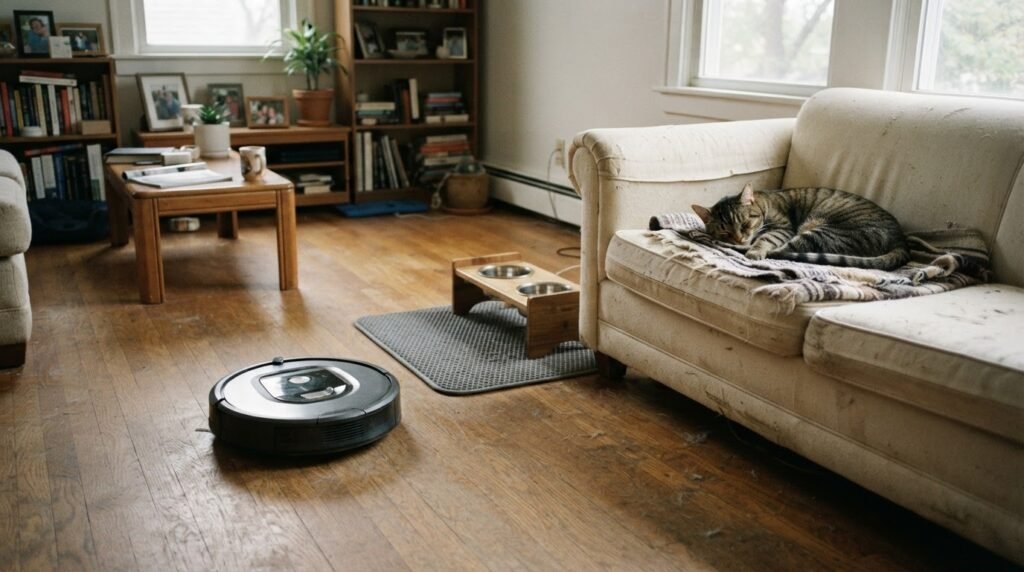
The litter box sits on tile. Your cat jumps out, takes three steps across the hall, and disappears under the sofa. By breakfast you can trace the whole trip in bare feet. If that sounds familiar, start with the surface where the trail ends. Our first pick for dry grit moving from hard floor onto a rug is the Roborock Saros 20. If most of the hair lands under a low couch, measure the opening first: the slimmer Dreame may buy you access to a patch of floor you rarely clean.
These five premium 2026 models solve different parts of that journey. We compared US model specifications, manufacturer launch materials, and published independent testing where available. The room setups below are our buying analysis. As an Amazon Associate, Paws & Spells earns from qualifying purchases.
Match the machine to your cat’s route
| Where the mess collects | Model to consider | What earns its place |
|---|---|---|
| Dry grit on tile and fur on a runner | Roborock Saros 20 | Strong pickup across those two surfaces in independent testing |
| Hair under a low sofa or crowded chairs | Dreame X60 Max Ultra Complete | Low body and obstacle navigation |
| The washable floor between the feeding area and living room | eufy Omni S2 | A self-cleaning roller plus detangling brushes |
| Several washable rooms used by multiple cats | Narwal Flow 2 | A rinsed track mop with onboard dirty-water collection |
| Dried food spots and fur around the breakfast nook | ECOVACS DEEBOT X12 OmniCyclone | Targeted pre-spray and a bagless station |
Take three measurements before shopping. Measure under the lowest sofa rail, between the litter mat and the wall, and across the narrowest gap between two chair legs. A robot that fits under a couch can still miss the floor behind it if its only entrance is too narrow. A folded tape measure in a store photo tells you more about fit than a wide-angle living room shot.
Roborock Saros 20: for the stretch from the litter mat to the rug
Start here if you hear grit on the hallway floor and see hair worked into the first few inches of the runner. Those are two pickups on one trip. Loose particles sit on the hard surface, while hair catches in fabric. RTINGS’ comparison of the Saros 20 and the Dreame X60 Max Ultra Complete found that the Roborock picked up more debris on hard flooring and removed carpet pet hair more effectively. That gives it a specific advantage in this layout. The test doesn’t establish how either model will handle your particular litter or mat.
The Saros 20’s adjustable chassis is part of what you are paying for. Look at the wood strip between a tiled utility room and the hall. If an older robot regularly turns around there, the most useful upgrade may be getting into the hallway at all. Roborock’s largest advertised crossing figure applies to a stepped obstacle. Measure each rise independently. A square vertical lip, a beveled strip, and the loose edge of a rubber mat present different approaches even when they reach the same height.
For the first run, leave the litter mat where your cat knows it and watch the robot approach from both directions. If the mat curls or grains collect underneath it, give that small rectangle a manual shake and let the machine handle the open floor beyond it. The result worth paying for is a hallway you can walk down comfortably every morning. Cleaning every inch of a flexible mat is a different job.
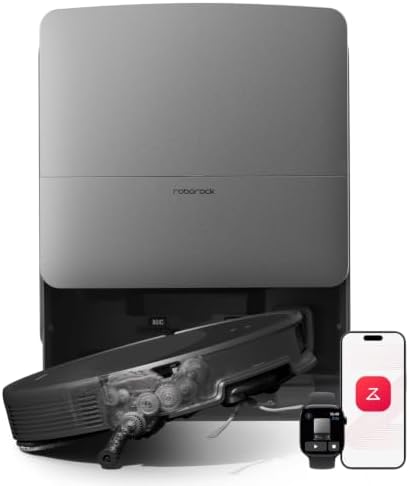
Dreame X60 Max Ultra Complete: for the sofa that collects the second cat
Run a flashlight sideways under the couch. If you find a strip of felted fur along the rear rail, take your measurement there too. A sofa can stand higher at the front than at its center, and a fabric dust cover can sag below the frame. Dreame lists the X60 Max Ultra Complete at 3.13 inches high, compared with 3.5 inches for the X50 Ultra. In a home with a genuinely tight opening, that fraction of an inch can change which rooms benefit from the purchase.
Another reason to consider the X60 is the way a cat household changes shape throughout the day. A cardboard scratcher gets pushed out, dining chairs sit at odd angles, and yesterday’s unobstructed shortcut becomes a dead end. In RTINGS’ head-to-head comparison, the Dreame negotiated furniture and obstacles more reliably than the Saros 20. Applied to your living room, that makes it an appealing choice when reaching the fur is the difficult part. It still needs dangling strings and wand toys put away before a run.
Try the first under-sofa trip while you are home. Watch whether the machine enters, turns, and finds its way back out without catching the upholstery. Then look behind the rear legs with the same flashlight. That second look answers the purchase question: did the upgrade reach the strip you used to clean on your hands and knees? A tidy map on the phone tells only half that story.

eufy Omni S2: separate the dry litter trail from the wet cleaning job
There are often two very different floors within a few steps of a cat’s bowl. The stretch leading out of the litter area needs dry pickup. The sealed floor beside the feeding mat may also have small dried food marks. The eufy Omni S2 makes the strongest case in the second space. Its HydroJet 2.0 roller refreshes its cleaning surface as it works, and the DuoSpiral brushes address hair on the vacuuming side. That combination gives you a reason to pay for both halves of the machine.
Picture setting up the kitchen after breakfast. Lift the feeding mat, remove the bowls, and pick up any wet food pieces by hand. The roller can now work on the exposed floor where the mat had been. Keep water away from loose clumping litter and follow your flooring manufacturer’s care directions. The practical distinction here is between a light dried film and a loose pile of material that turns sticky when damp. Both can be visible from the doorway, yet they call for different cleaning routines.
Consider where the station will live before committing to a large vacuum-and-mop system. Imagine carrying its dirty-water tank to a sink while holding a door open with your elbow. If the route is awkward, a feature you expected to use every evening may get used once a week. Give the clean-water tank and roller the same scrutiny as the robot itself. Both must be easy to reach in the spot you actually have available.

Narwal Flow 2: for washable floors shared by several cats
The Flow 2 uses a moving track as its mop. Narwal describes a system that rinses the track through multiple nozzles, scrapes it as it rotates, and collects used water inside the robot. Compared with the original Flow, the manufacturer increased the specified heated-water temperature from 113°F to 140°F. That number describes part of the cleaning system. It does not tell you the temperature of the floor or establish that a pass sanitizes a litter area.
The feature has a clearer meaning in a long room with two feeding stations. The first few feet might have a small patch of dried gravy, while the far end only needs a routine wipe. A continuously refreshed track gives used water somewhere to go during that trip. For a household comparing premium machines, the question is how often the route genuinely needs this wet stage. If most of the room is covered by rugs, estimate the exposed floor area before paying for a sophisticated mop.
The track also changes the aftercare question. A self-rinsing surface still leaves dirty water for someone to empty. Make a little space beside the sink where the tank can stand upright, and check that the route to the dock stays clear when a favorite cat bed is occupied. For a multi-cat home, the best station position is one that remains accessible without rearranging beds, bowls, or a sleeping animal.

ECOVACS DEEBOT X12 OmniCyclone: when the station matters as much as the robot
The X12 combines a roller mop with front-facing FocusJet pre-spray and a bagless dust station. Against its X11 predecessor, the wider roller and front spray are the changes most relevant to a hard-floor breakfast nook. You can see the attraction if you regularly lift the feeding mat to find yesterday’s dried food spots along its edge. Pre-wetting gives the roller a different starting point from rubbing a dry mark on the first pass.
There is an important buying detail behind that description. In its X12 review, RTINGS found that dried stains could still require repeated passes and that overall pickup trailed the X11 in its tests. Budget time for a quick hand wipe on stubborn spots. If you want the X12 specifically, the bagless station is the more predictable benefit: you can empty the dust receptacle without ordering replacement dust bags. Filters, the roller, and the station still need attention.
Think through the emptying step if your cat sheds fine hair in clumps. Locate the household bin, see how far you would carry the canister, and make sure you can lower it into the bin opening before releasing the contents. If you dislike handling dusty containers, that everyday detail deserves more weight than the visual appeal of the station. If you already empty a cordless vacuum the same way, it may fit neatly into your routine.

Protect the litter-box routine. Put the dock somewhere other than the entrance to the box. A cat should be able to approach, turn around, and leave even if the robot is parked. Our guide to why cats dig and cover in the litter box explains the behavior behind some of that scattered litter. Humane World for Animals also covers litter-box setup in its cat care guide.
Questions cat owners ask before ordering
Which feature matters most if my cat tracks litter but hardly sheds?
Start with dry pickup on the floor immediately beyond the mat. On your next sweep, notice whether you collect a small mound at the exit or a fine trail stretching around a corner. The mound argues for a better mat-emptying routine; the trail is a good job for a robot that can reach the whole route. For a wider comparison across price tiers, see our robot vacuum guide for pet owners.
Can the robot clean while my cat is using the box?
Schedule the first sessions when you can watch and give the cat an easy exit. Start in a different room, then observe both the cleaning run and the station’s louder emptying cycle. A cat that ignores a moving vacuum may still avoid a doorway beside a noisy dock. Use what your own cat does to choose the time and station location.
How can I tell whether the premium was worthwhile?
Choose three repeatable checkpoints: the turn outside the litter room, the back edge of the sofa, and the first foot of the hallway rug. After several ordinary cleaning days, look at those exact spots and note how often you still reach for a broom. The machine that saves your particular daily sweep has earned its place in a way a suction figure alone could never show.